How Casino Language Frames Thái Nguyên Stories
Read casino language in Thái Nguyên stories to distinguish borrowed imagery from a story’s central subject and see how framing shapes readers’ expectations.

The common mistake in reading casino language in Thái Nguyên stories is letting the label set the story’s subject before checking what the story actually centers. That can make a passing comparison feel like the main event. Instead, look at the people, images, and details the piece gives the most attention.
Follow the story’s focus
A casino reference can function as atmosphere, a visual motif, a comparison, or the subject of a report. Those choices shape how readers imagine a place, even when the text makes no claim about local activity. Note where the reference appears and what surrounds it.
Check the headline, opening, image caption, and central scene. If the word appears in a headline but the body follows an artist describing a set, the story’s focus may be stage design rather than gambling. If a photograph uses casino-like lights, ask whether the caption identifies them as decor, a metaphor, or a real venue.
Pay attention to repetition and emphasis. A term repeated in captions and subheads can make an image feel more central than the reporting supports. Record what the story spends time showing, not just the word that first caught your eye.
Read the visual frame
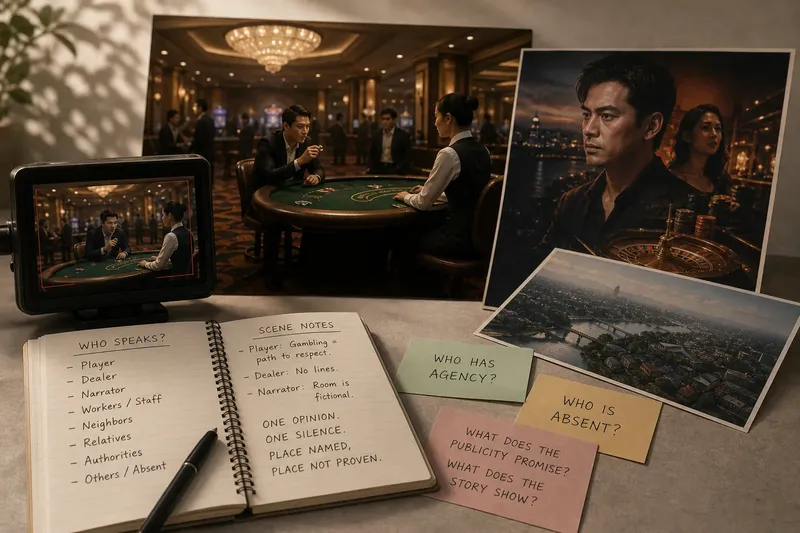
Images can lend a story a mood before readers reach its details. Neon colors, cards, tables, or a dramatic doorway may signal glamour, danger, secrecy, or spectacle. Those associations come from the presentation; they do not by themselves establish what a pictured place is or what occurs there.
Compare the image with its caption and the text beside it. Does the caption identify a designed backdrop or a real setting? Does the article explain why the image was chosen? If not, describe the visible element and leave its meaning open rather than assigning intent to the photographer or editor.
Consider who appears in the frame. A story that shows only an atmospheric room may give readers a mood without giving them people who can explain the setting. If residents or workers appear, check whether the text names their role and lets them speak as individuals.
Notice who is centered
Framing also comes from whose perspective organizes the story. A promoter may describe a visual theme, an artist may explain a design choice, and a reporter may supply context. These voices are not interchangeable. Identify who is speaking and whether the piece distinguishes their views from its own narration.
Watch for broad labels such as “locals” or “the community.” They can flatten different experiences into one imagined response. If the article gives no individual voices, describe that absence as a feature of the coverage, not as evidence that residents agree or feel a particular way.
Ask what the story leaves unexplained. A detailed account of a set’s appearance may say little about how local readers interpret it. A striking image may dominate while the people connected to the setting remain unnamed. Keeping those gaps visible helps readers assess representation without filling them with assumptions.
Make a framing note
Use this short checklist while reading. Each observation leads to a specific editorial choice:
- Headline emphasis: If the casino term appears only in the headline, describe it as headline framing; if it recurs in the body, note the passages that make it part of the story’s focus.
- Opening scene: If the article opens with a person explaining a design or image, identify that as the entry point; if it opens with an asserted event, look for the details that establish the event before describing it as the focus.
- Image and caption: If the caption identifies a set or illustration, call it a visual representation; if the caption does not explain the image, describe what is visible and leave its setting or purpose unresolved.
- Speaker’s role: If the person’s role is stated, attribute the view to that role; if it is missing, write that the source’s position is unclear rather than treating the view as representative.
- Repeated imagery: If casino motifs appear in several places, note how repetition shapes the presentation; if they appear once, describe them as a limited motif rather than the story’s organizing frame.
- People in the frame: If named people explain their connection to the subject, include that perspective; if the piece offers only a collective label, state that individual views are not supplied.
- Unexplained associations: If the text links imagery to a stated idea, attribute that connection to the source; if no reason is given, report the image and leave the intended association open.
Say you are editing an invented arts profile whose headline uses “casino,” while its opening follows a lighting designer preparing a stage backdrop. The caption identifies a painted card motif, and the designer says the visual direction is meant to suggest spectacle; the article does not describe a casino venue. You mark the headline as an attention-grabbing frame, describe the backdrop as the story’s concrete subject, and attribute the intended mood to the designer. The result keeps the evocative language while avoiding a claim the piece does not make.
Questions about framing?
What makes a motif the story’s focus?
Look at what the article develops through its scenes, sources, and explanations, not just what appears in the headline. A single casino-like image may be a motif; sustained reporting about that image can make it a central subject.
How should an ambiguous image be described?
State what is visibly present and what the caption identifies. If neither establishes the setting or purpose, leave those points unresolved instead of inferring them from the image’s style.
Can a headline change a story’s tone?
Yes. A vivid label can prime readers to expect spectacle or risk even when the body has a narrower focus. Describe that contrast when the headline and article emphasize different things.
What does an absent local voice tell readers?
It tells readers that the story does not provide that perspective; it does not reveal what residents think. Keep the observation tied to the coverage and avoid speaking for people who are not quoted.
Choose precise wording
When describing casino language in Thái Nguyên stories, name the framing device and the material the article actually develops. “The headline invokes casino imagery, while the profile focuses on stage design” is more precise than calling the piece a report about casino activity.
Small wording choices can preserve both the image and its limits. Say “casino-inspired backdrop” when the text describes a design influence, and “casino motif” when the reference is visual but its purpose remains unexplained. That phrasing lets readers see how the story creates an impression without mistaking the impression for the story’s subject.