How to Read Casino News About Thái Nguyên
Read casino news about Thái Nguyên by separating its claims, sources, and images, so you can tell what the report establishes and what remains unknown.
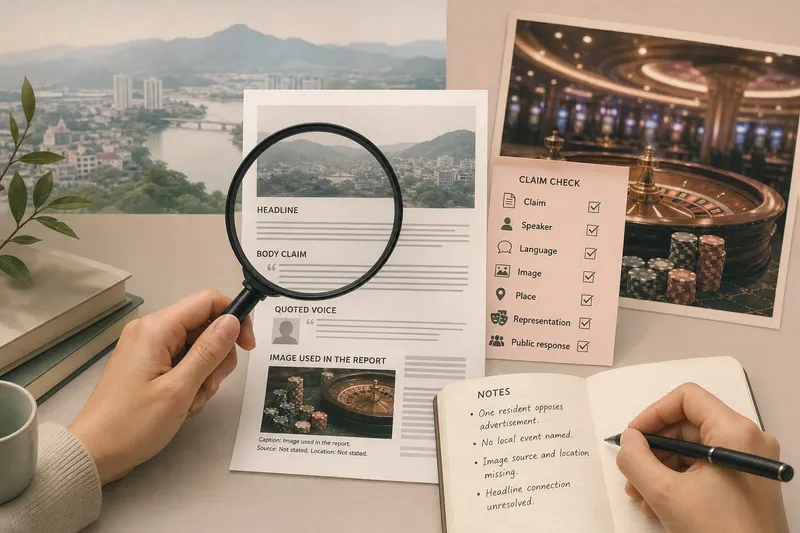
The most common mistake in casino news about Thái Nguyên is treating a headline or striking image as proof of local activity; that can turn a story about representation into a claim about a place. To read casino news about Thái Nguyên carefully, separate what the report says from what its wording and images suggest.
Find the actual claim
Start with the article body, not the headline. Identify its main subject: public language, a policy, a media portrayal, a named venue, or a specific event. These subjects can overlap, but they do not establish the same thing.
Write down the main claim as a short sentence. Then note what the report offers to support it: a quoted speaker, a public document, a caption, or a description of an event. If the article analyzes a casino-themed poster, for instance, that supports a discussion of the poster’s framing; it does not by itself document a casino in the province.
Track the language
Words such as “casino,” “gaming,” “gambling,” and “entertainment” carry different meanings. Note who uses each term: a speaker, an official document, a headline writer, or the reporter. Keep a quoted label attached to its source unless the article independently adopts it.
Compare the headline, caption, and body. If a headline uses a broad description but the body makes a narrower claim, use the narrower wording when discussing the story. Also notice evaluative words that frame an activity as glamorous, threatening, ordinary, or controversial. Ask whether the article attributes that judgment or presents it in the publication’s own voice.
Place images carefully
A photograph, poster, film still, or illustration can influence how readers picture casino culture. It does not automatically document a local venue, event, or audience. Read the caption and look for the image’s stated source, location, and purpose, such as archival, promotional, or illustrative.
When the source or location is missing, describe the image as an image used in the report. Do not connect it to Thái Nguyên solely because the province appears elsewhere in the story. A promotional image may show how its publisher presents a subject; it cannot, on its own, establish how local residents respond.
Weigh voices and scope
Record who speaks and what role that voice plays. A resident’s comment, an official statement, a business representative’s description, and a public document contribute different kinds of information. Attribute each claim to the source that makes it.
One person’s comment establishes that person’s stated view, not a shared provincial opinion. An institutional statement establishes the institution’s position, not how people respond beyond it. Keep the scope of your summary no broader than the material in the report.
Check the report?
Does the headline state the whole claim?
Not necessarily. Compare it with the body and retain any limits or qualifications the headline leaves out.
Can one quotation represent local opinion?
No. Attribute the view to the person quoted, and do not present it as a consensus unless the report supplies a clear basis for that broader claim.
Does an image show a local venue?
Only when the report provides a reliable connection between the image and that place. If the source or location is missing, describe it as an image used in the report.
What should you do with an unresolved detail?
Name what the report establishes and what remains unclear. If the detail matters, check a relevant document or separate account, keeping each source’s contribution distinct.
Use a claim check
Before repeating a claim, inspect each part and choose what the available material supports:
- Claim: If the body names a specific statement or event, repeat that limited claim; if it offers only a broad headline, use a narrower detail from the body or say the claim is unconfirmed.
- Speaker: If a source is named and the view is attributed, report it as that source’s view; if attribution is unclear, do not present the view as settled fact and seek a clearer source.
- Language: If a loaded term appears in a quotation or document, identify who used it; if its source is unclear, avoid assigning that wording to residents or the wider public.
- Image: If the caption names the image’s source and context, use only that stated context; if either is missing, describe it as an image used in the report and do not infer a local scene.
- Place: If the body connects Thái Nguyên to a named source, setting, or event, state that exact connection; if the province appears only in passing, do not infer local activity and look for a more direct account.
- Representation: If the story explains what a poster, film, or image is meant to convey, describe that framing; if it gives no basis for the interpretation, present it as your reading or leave it out.
- Public response: If the report presents distinct voices and explains their basis, summarize that range; if it quotes one person, attribute the response to that person and do not generalize.
Apply the distinctions
Imagine a report with a headline mentioning Thái Nguyên, a body quoting one resident who objects to a casino-themed advertisement, and an image caption that names neither source nor location. Those are the starting details: one attributed comment, a place name in the headline, and an image with no stated context.
Record the resident’s objection as that person’s response. Check the body for a named local event or an explanation of the headline’s connection to the province; in this imagined report, it provides neither. Describe the image as an image used in the report, not as a picture of a local venue.
The account you can responsibly give is that the report describes one resident criticizing an advertisement, while leaving the headline’s local connection and the image’s location unresolved. You can discuss its language and representation without presenting either as evidence of broader public opinion or local activity.
For casino news about Thái Nguyên, keep the exact claim, its source, and its unresolved details together in your notes. That makes it easier to discuss media framing accurately, especially when an image is used in the report but its source or location is missing.