When a Casino Scene Is Mistaken for a Real Place
Learn how casino scenes frame Thái Nguyên through language, casting, and publicity, and how to describe that portrayal without turning a story into local fact.
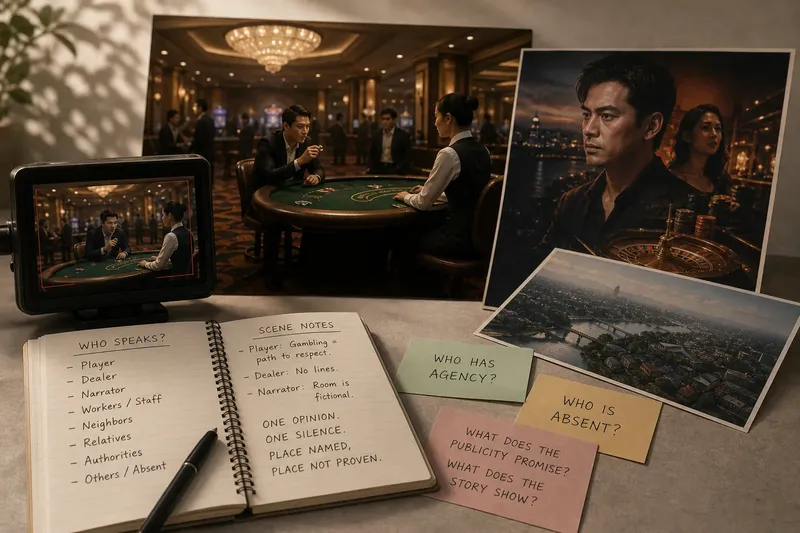
The most common mistake in writing about casino culture in Thái Nguyên is treating a screen character as a spokesperson for the province. It costs residents their varied voices and leaves readers with a narrow, dramatic picture in place of public life.
Notice who gets to speak
Start with the people the production gives lines to. A script may center players, owners, police, or journalists while leaving workers, neighbors, relatives, and people who avoid gambling offscreen. That selection is a representational choice, not a survey of local opinion.
Make a speaker list while watching: note each role, what they say about gambling, and whether the scene gives anyone a chance to challenge them. If one character calls a casino a source of status, write that the character makes the claim. Do not turn the line into a statement about what people in Thái Nguyên believe.
- One dominant voice: If a single character defines the issue, attribute the view to that character; if others are absent, describe the scene as limited in perspective rather than filling in their opinions.
- Conflicting voices: If characters disagree, describe the disagreement; if the edit favors one side, note the cue, such as whose reaction receives emphasis.
- Workers shown only as scenery: If staff have no lines, say the production gives them no voice; if they speak, describe their specific role without treating one character as representative of all workers.
- Family or neighbors omitted: If their perspective is missing, identify that gap; if the story includes them, report what those characters say rather than generalizing beyond the scene.
- Authorities presented as decisive: If an official character supplies the explanation, attribute it to the script; if no independent context appears, do not present it as an account of actual public policy.
- Comic or threatening treatment: If music, reaction shots, or dialogue push a character toward a stereotype, name the specific cue; if the scene resists that framing, describe the counter-cue instead.
Read roles and status
Casino stories often use familiar roles: the reckless player, the calculating operator, the corrupt official, or the person who rescues a family member. Those roles can make a plot legible quickly. They can also reduce a complicated subject to a few stock characters.
Look at who has agency. Who makes decisions, controls money, explains the rules, or gets the last word? A character may appear in many scenes yet have little control over the story. Describe that imbalance through what the scene shows, not through assumptions about real residents.
Track local language
Words, accents, and subtitles can create a sense of regional identity. A performer’s delivery may sound formal, comic, or familiar to a particular audience, but one scripted line cannot establish how people across Thái Nguyên speak.
Separate the spoken line from its subtitle when wording matters. Subtitles may condense or smooth dialogue; if you cannot assess the original audio, attribute the phrasing to the subtitle. Avoid naming a regional speech pattern unless the work or a reliable source supports that description.
Follow the publicity
Posters, thumbnails, trailers, and descriptions can shape expectations before a viewer sees the story. A thumbnail may emphasize a place name or a dramatic face, while the program itself offers little local detail. Treat each item as its own framing choice.
Ask what the promotional image invites viewers to infer. Does it present casino culture as glamorous, dangerous, comic, or socially ordinary? Identify the colors, wording, selected faces, or music that create that impression. Then distinguish the publicity’s promise from what the story actually shows.
Describe the portrayal?
Does one character represent Thái Nguyên?
No. A character represents a role written for a particular story unless the work provides a clear basis for a broader claim. Attribute opinions to the speaker and avoid extending them to residents generally.
What if a scene uses an accent?
Describe the audible delivery without assigning a regional origin you cannot verify. An accent performed by an actor is a creative choice, not proof of the performer’s or character’s local identity.
How should a stereotype be identified?
Name the role and the scene choices that make it familiar, such as a repeated visual cue or a one-note motive. Explain what the portrayal leaves out, rather than labeling a whole community through the character.
What does an absent voice mean?
It means the production does not include that perspective in the scene. It does not establish what the absent person or group thinks, feels, or experiences.
Work through a scene
Imagine an invented short drama with three speaking roles: a player, a dealer, and a narrator. Its opening card names Thái Nguyên; the player calls the game a path to respect, the dealer stays silent, and the narrator describes the room as fictional. The player’s claim is the only opinion about gambling, the dealer has no spoken perspective, and the fiction label limits what the room can establish about a real place.
To describe the scene, first record those three roles and their lines. Next, separate the opening card’s place reference from the narrator’s description of the room. Then write: “The drama links a Thái Nguyên reference to a fictional casino story, with the player presenting gambling as a route to respect while the dealer remains silent.” The tradeoff is clear: this sentence describes the production’s choices without making the player stand in for local residents.
Keep the claim narrow
Use a simple sentence pattern: identify the person or source, state what appears or is said, then name the framing choice. “The trailer gives the player the final line, making that character’s view dominant in the clip” is more precise than “the trailer shows how locals think.”
For casino culture in Thái Nguyên, careful wording does not require dull writing. It lets you analyze casting, dialogue, silence, and publicity while keeping the distinction between a screen portrayal and the people whose lives the story invokes.